

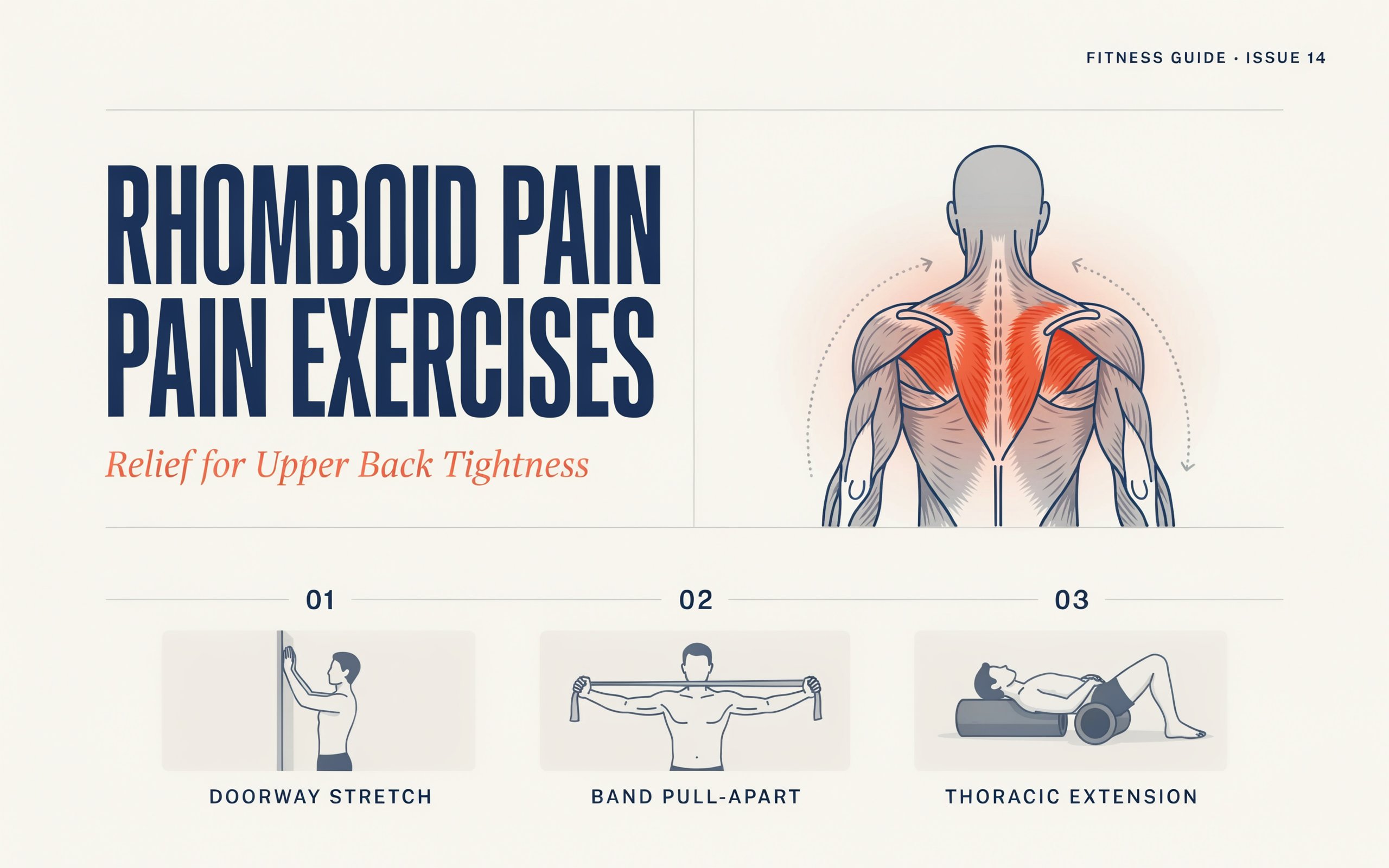
That nagging ache right between your shoulder blades — the one that makes you want to reach back and dig your knuckles into it — is often your rhomboid muscles asking for attention. Tucked beneath your trapezius, the rhomboids connect your shoulder blades to your spine, and they work overtime stabilizing your posture, especially if you spend hours hunched over a desk or phone.
The good news is that rhomboid pain usually responds well to a combination of targeted stretches and strengthening exercises. In this guide, we’ll cover what causes rhomboid pain, the best exercises to relieve and prevent it, and when it’s worth seeing a professional instead.
Meet the Rhomboids: The Muscles Behind That Upper Back Ache
The rhomboid major and minor are muscles located between your shoulder blades, responsible for retracting (pulling together) your shoulder blades and supporting good posture. Because they’re constantly working to counteract the forward-rounding pull of modern desk life, they’re one of the most commonly strained and tight muscle groups in the upper back.
Common causes of rhomboid pain include:
- Hours of slouching or craning your neck forward while seated
- Overuse from repetitive pulling motions, like rowing exercises or certain sports
- Muscle strain, from sudden movement or lifting with poor form
- Weakness combined with tightness, where underused rhomboids become both weak and chronically tense
- Carrying heavy bags on one shoulder repeatedly, creating muscular imbalance
Signs of Rhomboid Pain
- A nagging ache, or sometimes a sharp pain, right between your shoulder blades
- Tightness or a “knot” sensation in the upper back
- Discomfort that intensifies the longer you sit or slouch
- Discomfort when pulling your shoulder blades together
- Occasionally, a crackling or popping sensation with movement
Best Rhomboid Pain Exercises and Stretches
1. Doorway Chest Stretch
While this targets the chest, it indirectly relieves rhomboid tension by counteracting the rounded-shoulder posture that often causes rhomboid tightness in the first place.
- Stand facing a doorway, forearm resting on the frame, elbow bent at a right angle
- Gently lean forward until you feel a stretch across your chest
- Hold for 20–30 seconds per side
2. Cat-Cow Stretch
- Get into a tabletop position on your hands and knees
- Arch your back (cow position), then round it (cat position), moving slowly between the two
- Repeat for 8–10 slow rounds, focusing on mobility through your upper back
3. Seated Rhomboid Stretch
- Sit tall and extend one arm across your body at chest height
- Use your opposite hand to gently pull the extended arm closer
- Hold for 20–30 seconds per side, feeling the stretch between your shoulder blade and spine
4. Thread the Needle
- Start on all fours, then slide one arm underneath your body, rotating your torso toward the floor
- Hold for 20–30 seconds, feeling a stretch through the upper back and shoulder
- Repeat on the other side
5. Band Pull-Aparts (Strengthening)
- Grip a resistance band with both hands, arms stretched out in front of you
- Draw your shoulder blades together as you pull the band apart
- Perform 2–3 sets of 12–15 repetitions
6. Seated or Standing Rows (Strengthening)
- Using a resistance band or cable machine, pull the handles toward your torso, squeezing your shoulder blades together at the end of the movement
- Perform 2–3 sets of 10–12 repetitions
7. Scapular Squeezes
- Sit or stand with arms relaxed at your sides
- Bring your shoulder blades together, hold for a 5-count, then let go
- Do this 10 to 15 times, two or three times throughout the day
8. Foam Rolling
- Lie on your back with a foam roller placed crosswise beneath your upper back
- Slowly roll from your mid-back up toward your shoulders, pausing on tender spots
- Spend 30–60 seconds working through the area
Building a Routine for Rhomboid Pain Relief
A balanced approach works best — stretching alone won’t address underlying weakness, and strengthening alone won’t release existing tightness. Try combining:
- Stretch two to three times daily, especially after sitting for long stretches
- Strengthening exercises 2–3 times a week to build lasting support for your posture
- Posture breaks every 30–45 minutes if you work at a desk
If you’re also dealing with tightness in your lats, our guide on lat muscle stretches covers the neighboring muscle group, since lat and rhomboid tightness often occur together.
Preventing Rhomboid Pain
- Set up your workstation so your monitor is at eye level, reducing forward head posture
- Build in regular breaks to stand up, stretch, and reset your posture
- Strengthen your upper back consistently, not just when pain flares up
- Avoid carrying heavy bags on one shoulder repeatedly
- Warm up before pulling-focused exercises to reduce strain risk
When to See a Doctor or Physical Therapist
Most rhomboid pain improves with consistent stretching and strengthening, but you should see a professional if you experience:
- Pain that doesn’t improve after a couple of weeks of consistent exercise
- Sharp, severe pain, especially after a specific injury
- Numbness or tingling radiating down your arm
- Pain that interferes with daily activities or sleep
According to Healthline, persistent upper back pain that doesn’t respond to basic stretching and posture correction is worth having evaluated, since it can occasionally point to a more significant muscle or nerve issue.
Frequently Asked Questions
What causes rhomboid pain between the shoulder blades?
What’s behind the ache between your shoulder blades? Usually it comes down to poor posture, too much sitting, strain from pulling movements, or an upper back that’s both weak and tight.
How long does it take for rhomboid pain to heal?
How long until rhomboid pain gets better? A mild strain typically eases within one to two weeks with regular stretching and better posture. More serious strains may need several weeks.
What’s the best exercise for rhomboid pain?
A combination works best — scapular squeezes and band pull-aparts for strengthening, paired with the seated rhomboid stretch and thread-the-needle for flexibility.
Can bad posture cause permanent rhomboid pain?
It’s unlikely to be permanent, but chronic poor posture can lead to ongoing or recurring rhomboid tightness and pain if not addressed through consistent stretching, strengthening, and posture awareness.
Should I stretch or strengthen first for rhomboid pain?
Both matter, but if pain is acute, starting with gentle stretching and posture correction is usually more comfortable before progressing into strengthening exercises as discomfort eases.
Final Thoughts
Rhomboid pain between the shoulder blades is incredibly common, especially for anyone who spends long hours sitting or working at a desk, and it usually responds well to a mix of targeted stretching and strengthening exercises. Consistency matters more than intensity here — a few minutes of stretching and a couple of strengthening sessions each week can make a real difference over time. If the pain persists or comes with numbness or sharp sensations, it’s worth having a professional take a look.