

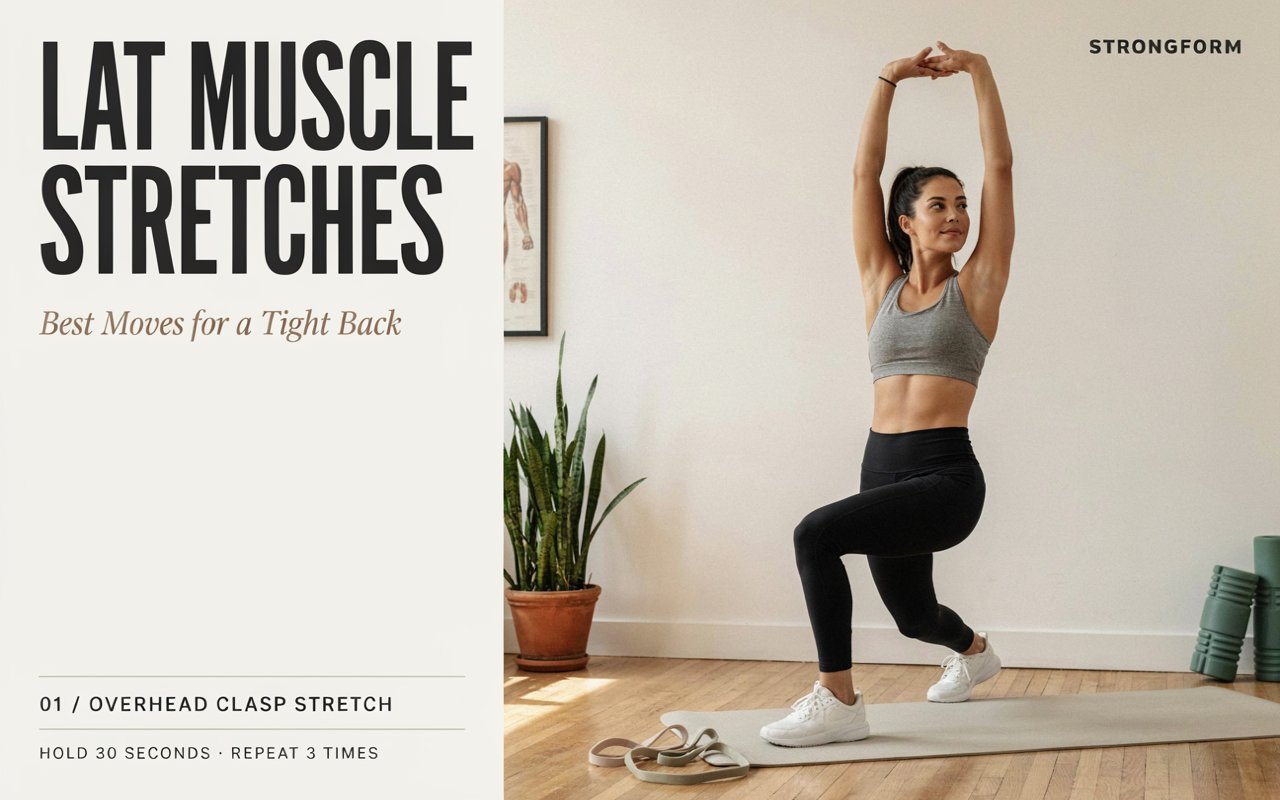
If reaching overhead feels tighter than it should, or your shoulders round forward no matter how much you try to correct your posture, your latissimus dorsi — better known as your lats — might be the culprit. These broad, wing-shaped muscles that stretch from your lower back up to your upper arms play a bigger role in daily movement than most people realize, and when they get tight, it shows up almost everywhere: your posture, your overhead reach, and even how your lower back feels during workouts.
The good news is that lat tightness responds well to consistent stretching. In this guide, we’ll cover why your lats get tight in the first place and walk through the most effective lat muscle stretches you can add to your routine, whether you’re recovering from a workout or just trying to move more freely.
What Are the Lats and Why Do They Get Tight?
The latissimus dorsi are large, flat muscles running along either side of your back, connecting your spine, shoulder blades, and upper arms. They’re heavily involved in movements like pull-ups, rows, swimming strokes, and any pulling motion, which is why they’re a common source of tightness for people who lift weights or do upper-body-focused training.
Common causes of tight lats include:
- Heavy pulling exercises (rows, pull-ups, lat pulldowns) without adequate stretching afterward
- Long hours of desk sitting, especially with slouched shoulders or poor posture
- Overuse from repetitive overhead activity, like swimming or throwing sports
- Muscle imbalances, where the lats compensate for weaker surrounding muscles
Left unaddressed, tight lats can contribute to reduced shoulder mobility, rounded posture, and even lower back discomfort, since the lats attach down into the pelvis and lower spine.
Signs Your Lats May Be Tight
- Difficulty raising your arms fully overhead
- A pulling or restricted feeling along the sides of your back during overhead reaches
- Rounded shoulder posture that’s hard to correct
- Lower back tightness, particularly after pulling-heavy workouts
- Reduced range of motion during exercises like overhead presses or pull-ups
Best Lat Muscle Stretches
1. Overhead Lat Stretch
- Stand or kneel with your arms raised overhead
- Grab one wrist with the opposite hand and gently lean to the side
- Hold for 20–30 seconds, then switch sides
- Focus on lengthening through the side of your torso, not just bending
2. Child’s Pose with Reach
- Start by kneeling comfortably, then slowly lower your hips back toward your heels while keeping your posture relaxed.
- Extend your arms forward on the ground, lowering your chest toward the floor
- For a deeper lat stretch, walk your hands slightly to one side, then the other
- Hold each side for 20–30 seconds
3. Doorway Lat Stretch
- Stand in a doorway and place one hand on the frame at shoulder height
- Slowly turn your torso away from the anchored arm until you feel a gentle stretch spreading through the side of your back and lat.
- Hold for 20–30 seconds per side
4. Kneeling Lat Stretch with a Bench or Chair
- Begin in a kneeling position a short distance in front of a stable bench or firmly supported chair.
- Place your hands on the surface and sit your hips back toward your heels
- Let your chest drop toward the floor, feeling the stretch through your lats and shoulders
- Hold for 30 seconds, breathing deeply
5. Side-Lying Lat Stretch
- Lie on your side with your bottom arm extended overhead along the floor
- Gently roll your top shoulder backward, opening up the chest and stretching the lat on your bottom side
- Hold for 20–30 seconds per side
6. Foam Roller Lat Release
- Lie on your side with a foam roller positioned under your armpit/lat area ]
- Slowly roll from your armpit down toward your mid-back, pausing on tender spots
- Spend 30–60 seconds per side
This is technically a self-myofascial release technique rather than a stretch, but it pairs well with active stretching to reduce tightness more effectively.
7. Cat-Cow with Lat Focus
- Start on all fours in a tabletop position
- As you gently round your spine into the cat position, extend your hands a little farther forward to deepen the stretch across your upper back and lats.
- Move slowly between cat and cow for 8–10 rounds
When to Stretch Your Lats
- Post-workout, especially after pulling-focused training like rows, pull-ups, or deadlifts
- As part of a daily mobility routine, particularly if you sit for long hours
- Before overhead activities, such as swimming, throwing sports, or overhead lifting, to improve range of motion
Holding each stretch for at least 20–30 seconds, rather than bouncing or rushing through it, tends to produce better results for improving flexibility over time.
Tips for Safe Stretching
- Warm up slightly before stretching cold muscles — even a few minutes of light movement helps
- Ease into each stretch until you feel a gentle pulling sensation, but stop if you experience any sharp or painful discomfort.
- Breathe steadily throughout each stretch rather than holding your breath
- Be consistent — occasional stretching helps less than a regular routine a few times a week
If you’re also dealing with soreness in your lower legs from training, our guide on soleus muscle pain causes and recovery covers similar rest-and-stretch principles for the calf.
When to See a Professional
Most lat tightness responds well to regular stretching, but you should consider seeing a physical therapist or doctor if you experience:
- Persistent pain that doesn’t improve with stretching
- Sharp, localized pain rather than a general tight or pulling sensation
- Numbness or tingling radiating down your arm
- Reduced range of motion that interferes with daily activities
According to, stretching routines should be adjusted or paused if any stretch causes sharp pain rather than the expected mild tension.
Frequently Asked Questions
How often should I stretch my lats?
Stretching your lats 3–4 times a week is generally enough to see improvements in flexibility, though daily light stretching is fine if it feels comfortable and pain-free.
Can tight lats cause lower back pain?
Yes. Since the lats attach down into the pelvis and lower spine, chronic tightness can contribute to lower back discomfort, especially during or after pulling-heavy workouts.
What’s the best lat stretch for beginners?
The doorway lat stretch and child’s pose with reach are both simple, low-intensity options that are easy to learn and safe for most fitness levels.
Should I stretch lats before or after a workout?
Static lat stretches are generally best saved for after a workout, when muscles are warm. Before training, light dynamic movement is usually more effective for warming up.
How long does it take to loosen tight lats?
With consistent stretching several times a week, many people notice improved flexibility within 2–3 weeks, though this varies based on how tight the muscles were to begin with.
Final Thoughts
Tight lats can quietly affect your posture, shoulder mobility, and even your lower back comfort, but they respond well to a consistent, simple stretching routine. Incorporating a few of the stretches above — especially after pulling-focused workouts — can noticeably improve flexibility and reduce tension over time. As with any stretch, aim for mild tension rather than pain, and check in with a professional if tightness turns into persistent pain or numbness.