

Scroll through social media and you’ll see it everywhere: a “lunchtime lift” that promises a sharper jawline, lifted cheeks, and tighter skin with no scalpel and little downtime. The PDO thread lift has become one of the most talked-about cosmetic treatments, and it’s easy to see why. But how much can it really do, how long does it last, and what are the risks?
In this guide, we’ll give you a balanced, no-hype look at the PDO thread lift: how it works, what results are realistic, the possible side effects, and how to choose a provider safely.
What Is a PDO Thread Lift?
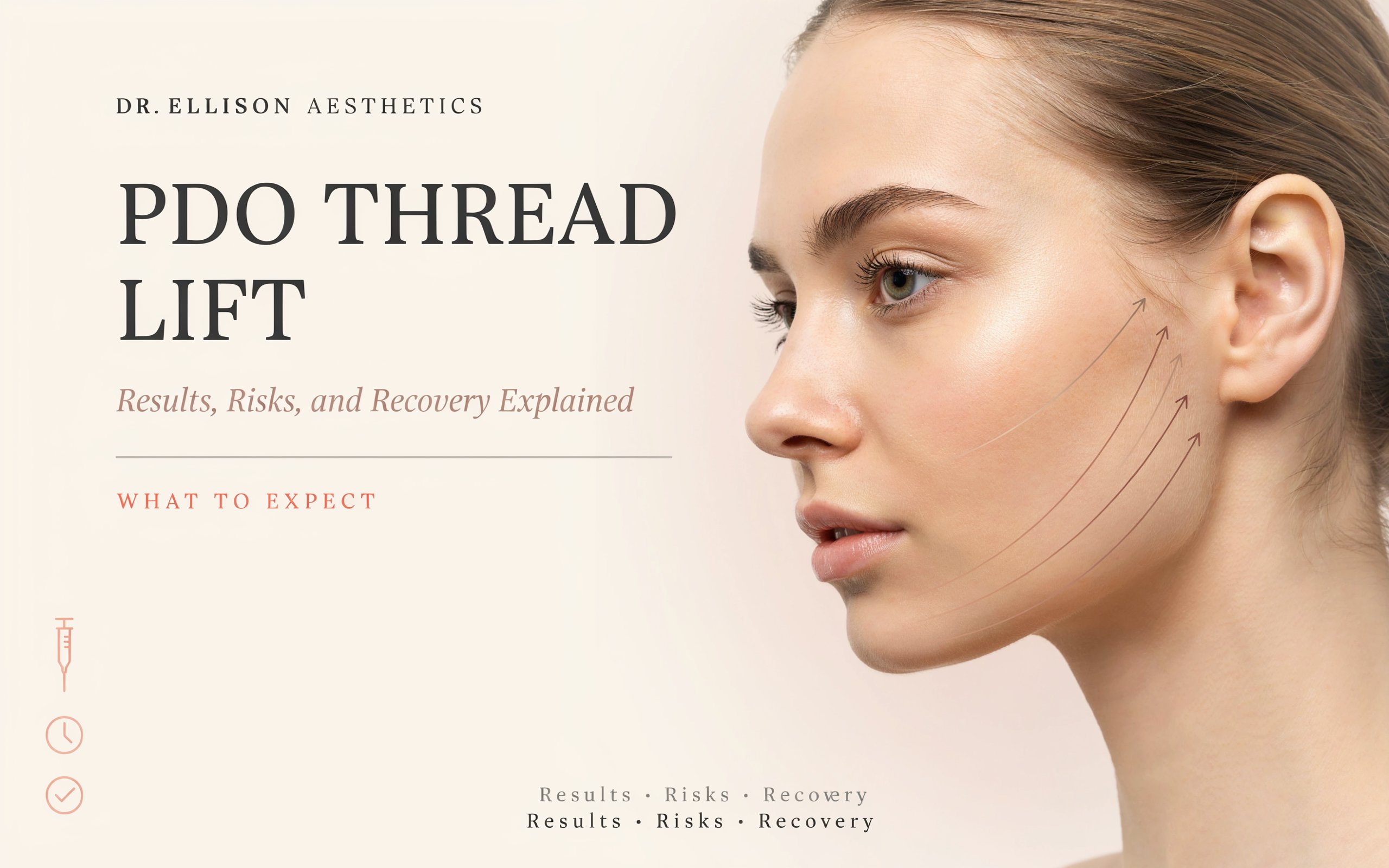
A PDO thread lift is a minimally invasive cosmetic procedure that uses fine, dissolvable threads made of polydioxanone (PDO), a material that has long been used in medical stitches. A trained practitioner places the threads under the skin using a fine needle or cannula. Some threads have tiny barbs or cogs that grip the tissue and lift it slightly, while smooth threads are mainly used to stimulate collagen and improve skin quality.
Over time, the threads dissolve, but the body’s response to them, including new collagen formation, can help maintain some improvement.
How Does It Work?
The threads work in two main ways:
- Mechanical lift. Barbed or cogged threads gently reposition sagging tissue, giving a modest lift
- Collagen stimulation. As the threads dissolve, the body produces new collagen around them, which can make skin look firmer and smoother over the following months
What Areas Can Be Treated?
Practitioners commonly use PDO threads on:
- The jawline and jowls
- Cheeks and mid-face
- Brows
- Neck
- Around the mouth and nasolabial folds
- Sometimes, other body areas
What Results Can You Realistically Expect?
This is where honesty matters. Thread lifts can produce a subtle, natural improvement for the right person, but they are not a replacement for a surgical facelift. Save Face, a UK register of accredited aesthetic practitioners, states that PDO thread lifts can give good results for carefully selected patients but are not a substitute for a surgical facelift, and that a clinic promising facelift-like results from threads should be treated as a red flag.
Realistic expectations include:
- A modest lift, often described as millimeters rather than dramatic change
- Gradual improvement in skin texture and firmness as collagen builds
- Best results for mild to moderate sagging, not heavy jowls or significant skin laxity
- Initial swelling that can make the first results look better than they’ll settle
Dermatologists quoted by RealSelf also note that research on thread lifts is still limited, and that managing expectations is a big part of satisfaction.
How Long Does a PDO Thread Lift Last?
PDO results are temporary. Different sources give different ranges, commonly from around six months up to about 12 to 18 months, depending on:
- The type and number of threads used
- Your age and skin condition
- Your lifestyle, including sun exposure and smoking
- How much lift was attempted
Results fade gradually as the threads dissolve, and the procedure can be repeated if you wish.
What Is the Procedure Like?
A typical session involves:
- Consultation. The practitioner reviews your medical history, assesses your skin, and discusses goals and risks
- Preparation. The area is cleaned and marked, and local anesthesia is given
- Thread placement. Threads are inserted under the skin and positioned for lift
- Finishing. Any excess is trimmed, and the area is treated for comfort
Sessions often last under an hour, and most people go home the same day.
Recovery After a Thread Lift
Recovery is usually fairly short, but it isn’t zero downtime. You may experience:
- Swelling
- Bruising
- Tenderness or tightness
- Mild discomfort when chewing or moving your face
- Small bumps or dimpling that often settle
Swelling and bruising commonly improve over a week or two. Your practitioner will give specific aftercare, which often includes:
- Gentle facial movements at first, avoiding wide yawning or exaggerated expressions
- Sleeping on your back with your head slightly raised
- Avoiding facial massage, strenuous exercise, and certain treatments for a period, as advised
- Using cold compresses if your provider approves
Always follow the instructions given by your practitioner, since they differ between techniques.
Risks and Side Effects
Like any procedure, thread lifts carry risks. Most complications are minor and temporary when performed by an experienced provider, but they can include:
- Bruising, swelling, and soreness
- Asymmetry or uneven results
- Dimpling or puckering of the skin
- Visible or palpable threads under thin skin
- Infection
- Thread migration or the thread poking through the skin
- Nerve irritation or temporary numbness
- Hematoma (a collection of blood under the skin)
- Allergic reaction
- Results that disappoint or don’t last as long as hoped
Serious complications are uncommon, but they’re a reason to choose your provider carefully.
Who Is a Good Candidate?
Thread lifts tend to suit people who:
- Have mild to moderate skin sagging
- Have reasonably good skin elasticity
- Want a subtle refresh with minimal downtime
- Understand the results are temporary and modest
Who Should Avoid It or Be Cautious?
Speak with a doctor first if you:
- Have significant sagging or heavy jowls (surgery may suit you better)
- Are pregnant or breastfeeding
- Have an active skin infection or inflammatory skin condition in the area
- Have a bleeding disorder or take blood-thinning medication
- Have a tendency to form keloid or thick scars
- Have an autoimmune condition or other health condition affecting healing
- Have unrealistic expectations
How to Choose a Provider Safely
Who does the procedure matters as much as the procedure itself.
- Check qualifications. Choose a licensed doctor, such as a dermatologist or plastic surgeon, or a qualified, regulated practitioner working under medical supervision. In your own country, check the practitioner’s registration with the national medical regulator, for example, the PMC in Pakistan
- Ask about experience. How many thread lifts have they performed, and what do they do if something goes wrong?
- Ask about the product. Make sure threads are genuine, sealed, and from a reputable manufacturer
- Look at real before-and-after photos of their own patients, not stock images
- Avoid unlicensed salons, home treatments, and “deal of the day” offers. Cosmetic procedures aren’t something to price-shop
- Beware of exaggerated promises, such as “a facelift without surgery”
- Expect a proper consultation covering risks, alternatives, and aftercare, with no pressure to book on the spot
Alternatives to Consider
Depending on your goals, a doctor may discuss other options, each with pros and cons:
- Sun protection and a good skincare routine, the foundation of healthy aging. See our guide to skin facts and care tips, and our article on gotu kola for a popular skincare ingredient
- Prescription retinoids
- Dermal fillers to restore volume
- Neuromodulator injections (such as botulinum toxin) for expression lines
- Energy-based treatments, such as radiofrequency or ultrasound
- Surgical facelift for significant sagging
As with any cosmetic product or treatment, do your research. Our article on whitening strips shows the same principle: check what a treatment can and can’t do before you buy.
When to Contact Your Provider or a Doctor
Contact your practitioner or a doctor if, after a thread lift, you notice:
- Increasing pain, redness, warmth, or swelling
- Pus or discharge
- Fever
- A thread poking through the skin
- Significant asymmetry or skin dimpling that doesn’t settle
- Numbness or weakness in part of your face
Seek urgent care for rapidly spreading redness, severe pain, fever with chills, or difficulty breathing or swallowing.
Frequently Asked Questions
Is a PDO thread lift permanent?
No. The threads dissolve over months, and results are temporary, typically fading over the following months to a year or more depending on the person.
Does a PDO thread lift hurt?
Local anesthesia is used, so most people feel pressure rather than sharp pain. Tenderness afterward is common.
How long is recovery after a thread lift?
Swelling and bruising often settle in about one to two weeks, though recovery varies. Follow your practitioner’s aftercare advice.
Is a thread lift better than a facelift?
They aren’t equivalent. Thread lifts offer a modest, temporary lift with little downtime, while a surgical facelift gives more dramatic, longer-lasting results with greater recovery.
Is a PDO thread lift safe?
It’s generally considered safe for suitable patients when done by a qualified, experienced provider, but like any procedure it has risks.
Can I get a thread lift if I’m in my 50s or 60s?
It depends on your skin laxity and goals. Thread lifts work best for mild to moderate sagging, so a consultation will show whether it’s right for you.
Final Thoughts
A PDO thread lift can be a reasonable choice for someone with mild to moderate sagging who wants a subtle, temporary refresh with minimal downtime. But it isn’t a facelift in disguise, results are modest and don’t last forever, and there are real risks. The best way to protect yourself is to set realistic expectations, choose a properly qualified and regulated practitioner, and take your time with the decision. If a deal or promise sounds too good to be true, it probably is.
Have you considered a thread lift? Share your questions or experiences in the comments, and pass this along to a friend who’s weighing her options.
This article is for informational purposes only and is not medical advice and does not endorse any procedure. Please consult a qualified, licensed doctor before undergoing any cosmetic treatment.