

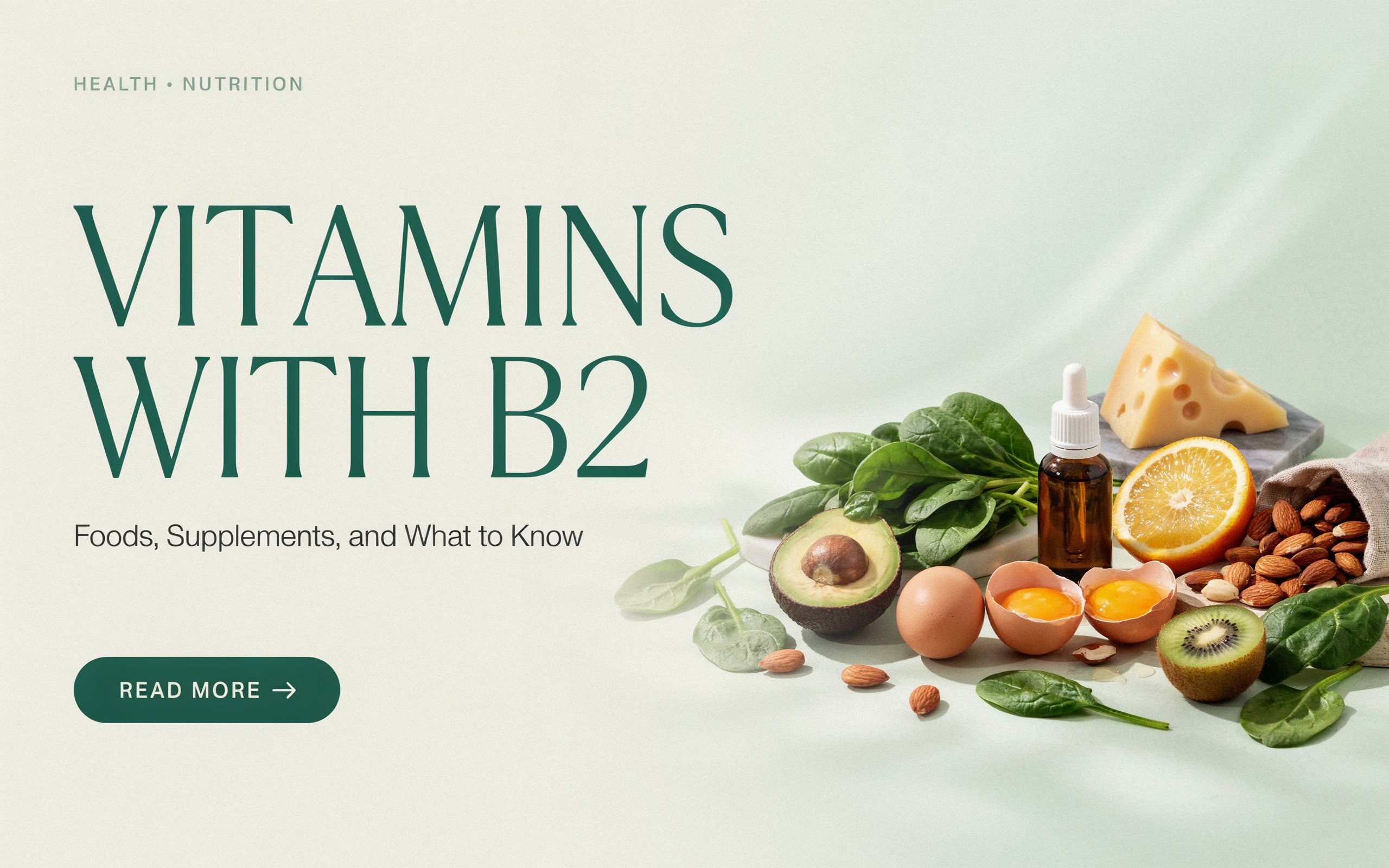
If you’ve been scanning supplement labels and wondering which vitamins include B2, you’re not alone. Vitamin B2, also called riboflavin, shows up in a surprising number of places: multivitamins, B-complex formulas, fortified cereals, and everyday foods like milk and eggs. But what does it actually do, how much do you need, and do you really need a supplement?
In this guide, we’ll explain what vitamin B2 is, which vitamins and foods contain it, the signs of low intake, and how to choose a supplement wisely.
What Is Vitamin B2 (Riboflavin)?
Vitamin B2, or riboflavin, is one of the eight B vitamins. It’s water-soluble, which means your body doesn’t store much of it and you need a regular supply. According to the NIH Office of Dietary Supplements, riboflavin is important for the growth, development, and function of the body’s cells, and it helps turn the food you eat into energy.
Riboflavin also works alongside other B vitamins and helps your body use nutrients like carbohydrates, fats, and proteins.
What Does Vitamin B2 Do?
- Supports energy production by helping convert food into usable energy
- Helps cells grow and function normally
- Supports healthy skin, eyes, and the lining of the mouth and digestive tract
- Works with other B vitamins, such as niacin, folate, and vitamin B6
- Acts as an antioxidant helper by supporting some of the body’s protective systems
Which Vitamins Contain B2?
You can find riboflavin in several types of products:
1. Multivitamins
Most multivitamin and multivitamin/mineral supplements include riboflavin. They commonly provide about 1.3 mg, which is 100 percent of the Daily Value.
2. B-Complex Supplements
B-complex vitamins combine all or most of the B vitamins in one product, usually including B1 (thiamin), B2 (riboflavin), B3 (niacin), B5 (pantothenic acid), B6, B7 (biotin), B9 (folate), and B12. If you’re looking for “vitamins with B2,” a B-complex is the most direct option.
3. Riboflavin-Only Supplements
Some products contain B2 on its own, often in higher amounts than a multivitamin.
4. Fortified Foods
Many breads, breakfast cereals, and other grain products are fortified with riboflavin.
When choosing any supplement, check the label for the amount per serving, and follow the directions on the package.
Foods That Contain Vitamin B2
You can usually get enough riboflavin from food. Good sources include:
- Milk and yogurt
- Eggs
- Cheese
- Beef liver and other organ meats, which are among the richest sources
- Chicken, fish, and lean meats
- Fortified breakfast cereals and enriched breads
- Almonds
- Mushrooms
- Spinach and other leafy greens
- Whole grains and legumes
Riboflavin is sensitive to light, so milk and other riboflavin-rich foods are best stored in opaque containers or in the dark rather than in clear containers left in bright light.
How Much Vitamin B2 Do You Need?
The NIH’s Recommended Dietary Allowances put typical daily needs at roughly:
- Adult men: 1.3 mg
- Adult women: 1.1 mg
- During pregnancy: 1.4 mg
- While breastfeeding: 1.6 mg
Needs for children and teens vary by age. Most people who eat a varied diet get enough riboflavin from food alone. Your doctor or a dietitian can advise on your personal needs.
Signs You Might Not Be Getting Enough
True riboflavin deficiency is uncommon in places where food is plentiful, but it can occur with a very poor diet, certain medical conditions, or heavy alcohol use. Possible signs include:
- Sore throat
- Cracks or sores at the corners of the mouth
- Swollen, red, or sore tongue and lips
- Skin problems, such as dryness or a scaly rash
- Eye irritation or sensitivity to light
- Tiredness and anemia in more severe cases
These symptoms can have many causes, so don’t self-diagnose. See a doctor to find out what’s going on rather than assuming it’s a vitamin problem. If low energy is your main concern, our guide on adrenal fatigue and energy support explains why diet, sleep, and medical checks matter before reaching for supplements.
Who May Need More Vitamin B2?
Some groups are more likely to fall short:
- Vegans and some vegetarians, if they eat few dairy products, eggs, or fortified foods
- Pregnant and breastfeeding women, who have higher needs
- People who drink heavy amounts of alcohol, which can interfere with absorption
- Those with certain digestive conditions that affect nutrient absorption
- Older adults with limited appetite or diet variety
- Athletes with heavy training and limited diet variety
Vitamin B2 and Migraines
Some studies have looked at high-dose riboflavin for preventing migraines, and some people report fewer attacks, but the evidence is mixed and doses used in studies are much higher than everyday vitamin amounts. If you live with frequent headaches, talk to a doctor before trying this, and see our article on head pain and dizziness for when symptoms need urgent attention.
Is It Safe to Take Vitamin B2?
Riboflavin has not been shown to cause harm at typical levels, partly because the body can only absorb a limited amount at a time and excretes the excess in urine. Many people notice bright yellow urine after taking a supplement. It’s harmless and completely normal.
Still, more isn’t necessarily better, and supplements should not replace a balanced diet. Check with your doctor or pharmacist before starting a supplement if you:
- Are pregnant or breastfeeding
- Have a medical condition
- Take regular medications
- Plan to take high doses
How to Choose a B2 Supplement
- Decide what you need. A multivitamin may be enough if you simply want general coverage. A B-complex is a better match if you want all the B vitamins together
- Read the label for the amount of riboflavin per serving and the percentage of the Daily Value
- Avoid megadoses unless a doctor recommends them
- Choose reputable brands that use third-party testing when possible
- Keep supplements somewhere cool, dry, and dark, and well out of children’s reach.
- Take them with food if they upset your stomach
For more detail, see the MedlinePlus overview of riboflavin.
When to See a Doctor
Talk to a doctor if you have:
- Persistent mouth sores, cracked lips, or a sore tongue
- Ongoing fatigue or weakness
- Skin or eye symptoms that don’t improve
- Concerns about your diet or absorption
- Plans to take a high-dose supplement
Frequently Asked Questions
What vitamins contain B2?
Multivitamins, B-complex supplements, and riboflavin-only products contain B2, and many fortified cereals and breads add it too.
Is vitamin B2 the same as riboflavin?
Yes. Riboflavin is the scientific name for vitamin B2.
What foods are high in vitamin B2?
Milk, yogurt, eggs, cheese, organ meats, lean meats, fortified cereals, almonds, mushrooms, and leafy greens are all good sources.
How much vitamin B2 do I need daily?
Adult men need about 1.3 mg and adult women about 1.1 mg per day, with higher amounts during pregnancy and breastfeeding.
Why does vitamin B2 turn urine bright yellow?
Riboflavin is naturally yellow-green, and excess amounts are passed through urine. It’s harmless.
Do I need a vitamin B2 supplement?
Most people get enough from food. A supplement may help if your diet is limited or a doctor recommends it.
Can you take too much vitamin B2?
It has not been shown to cause harm at typical levels, but it’s best not to take more than recommended without medical advice.
Final Thoughts
Vitamin B2 plays a quiet but important role in helping your body turn food into energy and keep cells working properly. You can find it in multivitamins, B-complex formulas, fortified foods, and everyday items like milk, eggs, and leafy greens, and most people with a varied diet already get enough. If you do choose a supplement, read the label, avoid unnecessary megadoses, and check in with a doctor if you have a health condition or take medication.
Do you take a B-complex or multivitamin? Share your experience in the comments, and pass this along to someone comparing supplement labels.
This article is for informational purposes only and is not a substitute for professional medical or nutritional advice. Please consult a doctor or registered dietitian before starting any supplement.